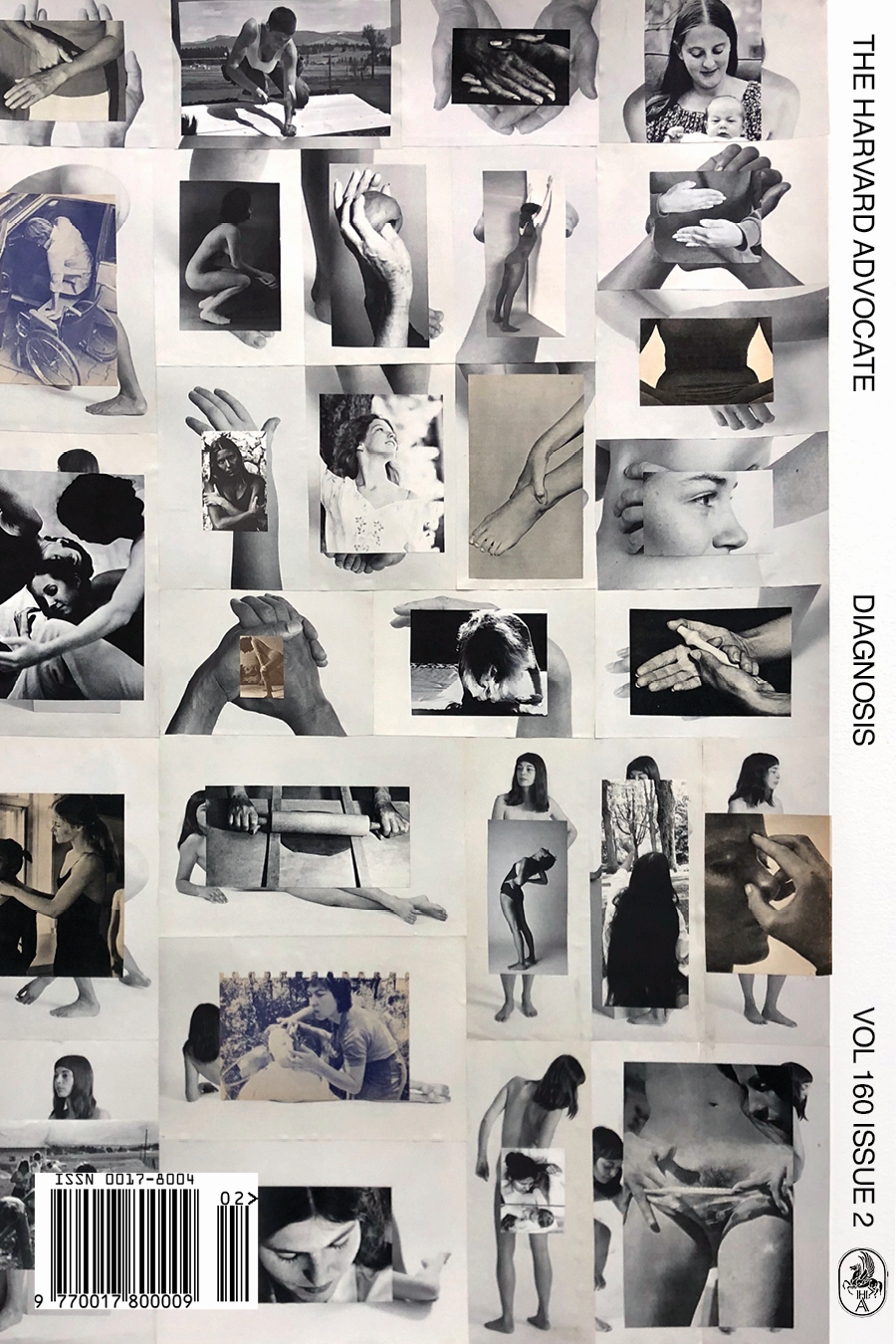
Features • Fall 2025 - Diagnosis
I was raised, for three years, in Virginia, where the elementary schools taught us that the Chesapeake was our bay, the Appalachias were our mountains. This was the Virginia I recall, singing an old folk song about the Shenandoah River Valley, Oh Shenandoah, the one that starts, “I long to see you,” and ends, “I’m bound to leave you.”
Poetry • Fall 2025 - Diagnosis
after Ellen Bass
O black bean boy, O owl eyes,
O package of muscle and fur.
My cautious companion, my
in-love-with-me friend. What will we do
without your low grumbles
your hot-water-bottle body
beside us all winter? O sun-scorched nose,
O wacky teeth that can’t bite a thing, O
fluted, veined callalily ears
taking the world straight to the heart.
There is no guy I’d rather sleep with,
no slinky tuxedo like yours.
When you frolic and hop
in your nightly routine, the sounds
of cracked glass and low howls
are like the heartbeats in a womb.
In that embryonic waterfall, we sleep.
Two lucky mothers.
O bloated bladder, O swollen,
sleepy heart. When we nearly lost you,
we sought you in our grief
to ease our grief. We held your exhausted body
to us. O seeing soul, O aperture closing and
widening, catching the landscape
of more than mere humans can know.
Beloved beast, dear body that heals and heals.
Tiny horse, honeyed contralto,
our leaping, whiskered seal —
Fiction • Fall 2025 - Diagnosis
W E The People entered the home of the Crisis Actor illegally. This is true. Why deny it? We certainly weren’t going to be invited in. There was the matter of him knowing our faces, from those days when we picketed on the gum-spotted sidewalk or confronted him at his car in a parking garage downtown, our accusations drowned out by the scrape of skater boys. And, of course, there was the restraining order. Legal lines had been drawn and, yes, we decided to cross those lines, which resisted no more ably than strands of cobwebs stretched across a basement doorway.
The fresh online pieces we experiment with outside of our print cycle. Formerly known as Blog.
Notes
The purposes of this review are twofold: first, to convey the eminently pleasant though not necessarily intellectually stimulating experience of seeing The Light in the Piazza at the Huntington Theater; and second, to convince you, yes YOU, the member of the Advocate reading this (or honestly whoever else) to take up my mantle of reviewing shows at the Huntington now that I have graduated.
From the Archives
Features • Winter 2016 - Danger
REPRINTED FROM 1980 MARCH ISSUE
*Gabriel García Márquez was born in Colombia in 1928. His *No One Writes to the Colonel and Other Stories* was published in America in 1968. *One Hundred Years of Solitude* followed in 1970; *Leaf Storm and Other Stories* in 1972; *The Autumn of the Patriarch* in 1976;* Innocent Erendira and other Stories* in 1978; and *In Evil Hour* in 1979.*
* *
*The following interview was arranged by Adam Nossiter, and took place on December 2, 1979.*
* *
*This is a direct transcription from the Spanish; *The Advocate* is grateful to Rodrigo Garcia for his kind service as interpreter.*
* *
**Advocate**: I’ll begin by asking how you started writing.
**García Márquez**: By drawing.
**Advocate**: By drawing?
**García Márquez**: When I was very little, before I could read or write, I would draw stories in cartoons.
**Advocate**: You then went on and became a journalist. How do you feel your training in journalism affected your writing?
**García Márquez**: I think they’re complementary activities. Working in journalism on an every-day basis lets you get loose and lose that timid respect you have toward writing, in the beginning, that is, when you begin doing journalism or fiction. Then you get to a point where journalism *has *done exactly that: enabled you to get used to writing, easily and every day. And then fiction gives you ideas for your journalism. So they are complementary activities. And, very important, journalism was a way of living, to make money while writing. In the long run, fiction has enabled me to improve the literary quality of my journalistic work, and journalism has helped me to be aware of every-day events, or every-day life, which is helpful for my fiction. With time, literature and journalism—which so far have been parallel activities—with time they will converge. Right now I am looking for a synthesis, similar to what Truman Capote did with *In Cold Blood*. That’s simply an example; I don’t consider it an influence. The ideal thing right now would be to find an event in every-day life that I could deal with from a literary point of view, in order to prove that there is very little difference, a very small gap, between journalism and literature. Also to prove that every-day events, that reality has the same literary value as, for example, poetry.
**Advocate**: Is that actually what you are working on now?
**García Márquez**: Right now I still haven’t come across that event to work on. So what I am doing is writing short stories based on true experiences of Latin Americans living in Europe. I am dealing with these events, these experiences not from a journalistic point of view, or as memoirs, but simply from a literary point of view, giving them a *literary *value. In any case, in all my books, in my entire work, I can demonstrate that there is not one single line, not one single sentence, that is not based on real life. I consider my great problem to be that I lack imagination. If life doesn’t give me a fact, I am unable to invent one. I am perfectly willing and able to prove that, line by line, sentence by sentence, in every single one of my books. If I had the time, I would consider writing a book in the form of memoirs, talking about the origins of every single fact and adventure in my books. This book would let me make fun of all the critics and analysts of my books, who come up with facts that have nothing to do with what is written.
**Advocate**: How did the extraordinary popularity of *One Hundred Years of Solitude *affect your writing? I think there’s a certain break there: *The Autumns of the Patriarch *is very different in style and theme.
**García Márquez**: Do you know *Leaf Storm*?
**Advocate**: Yes.
**García Márquez**: I’m not sure if people have noticed this, but I feel there is a very close relationship between *Leaf Storm *and *The Autumn of the Patriarch* my first and last books. A lot has been said to the effect that *One Hundred Years of Solitude* was the culmination, the climax, of all the books that came before. I feel that the culmination of my work thus far has been *The Autumn of the Patriarch*. The book I was looking for from the very beginning was *The Autumn of the Patriarch*. I’d even started *The Autumn of the Patriarch *before *One Hundred Years of Solitude*, but I’d found there was a sort of wall, something stopping me from actually getting into the book. The thing that stopped me was *One Hundred Years of Solitude*. I have the impression that every book is an apprenticeship for the next. There’s a progression from book to book—but it’s a progression that can be in one direction or another. Not really a progression, in fact, but an investigation, which takes place from book to book. In parentheses, within my own process of investigation and evolution, I believe that one book is the best of them all, and that is *No One Writes to the Colonel*. I say sometimes, jokingly, but I do believe it, that I had to write *One Hundred Years of Solitude *so that people would read *No One Writes to the Colonel*.
And with respect to the change in style between *One Hundred Years of Solitude *and *The Autumn of the Patriarch*, I found it easy for two reasons—no, three reasons. First of all, there was the relaxation created by my having written *One Hundred Years of Solitude*. I was less scared of any literary adventure. Secondly, *The Autumn of the Patriarch *was a very expensive book to write. I wrote for seven years practically every day. On lucky days, I’d be able to finish three lines the way I liked them. So in fact *One Hundred Years of Solitude* financed *The Autumn of the Patriarch*. The third reason for the different approach in *The Autumn of the Patriarch* was that the theme demanded it. Written in the rather linear fashion of *One Hundred Years of Solitude* or the other books, *The Autumn of the Patriarch *would have turned out to be just another story of a dictator. It would have been a very long story, and much more boring than it actually is. All the literary resources I used in *The Autumn of the Patriarch*, among which were flagrant violations of Spanish grammar, enabled me to say more in a shorter space and penetrate more deeply into all aspects of the book, because you don’t go down straight as in a lift, but in a sort of spiral.
The relationship between *Leaf Storm *and *The Autumn of the Patriarch* is that they are both basically on the same theme: they are both monologues around a corpse. When I wrote *Leaf Storm*. I had had very little literary experience, writing experience. I wanted to find a way of telling a story that happened within someone. At that time I found only two models to help me with this. One was Faulkner’s *As I Lay Dying*. The book is a series of monologues, in which each monologue is preceded by the name of the character it belongs to. I liked Faulkner’s method, but I didn’t like the fact that he had to pinpoint each of the characters; I think character has to identify itself in the course of the monologue. The second model was *Mrs. Dalloway, *though I realized that the technique of interior monologue in Virginia Woolf’s work required an extraordinary literary training, which I didn’t have at the time. I found a compromise between these two models, a formula for monologue that lets you recognize the characters without having to be given their names. That of course is a limitation, because in order to avoid confusion I had to deal with only three characters. I chose an old man, whose voice was recognizable because hew was old, his daughter, whose voice is easily recognized. Mixing together these monologues and leading the reader around, that was my approach in structuring the novel. Twenty-five years later, with five books behind me, and with the security from every point of view which *One Hundred Years of Solitude *had given me, I could plunge into the adventures of *The Autumn of the Patriarch* without fear of breaking my head. It’s a multiple monologue, where it no longer matters who is speaking. It arrives at what I’d been looking for for twenty years, which is a social monologue. What is talking in the books is the whole of society; it’s everyone. They just simply pass the words from one to another: it does not matter who is speaking.
**Advocate**: Which suits the subject, because it is to such a large extent a political novel.
**García Márquez**: I feel a theme like that cannot be treated in any other way. I can tell you about the other formula I had for *The Autumn and the Patriarch*, which I didn’t use.
**Advocate**: Please do.
**García Márquez**: Many years before writing *One Hundred Years of Solitude* I started writing *The Autumn of the Patriarch *as a very long, single monologue, that of the dictator as he was being put on trial. The first line of the book was “Before we begin, take those lights away from here!” That monologue enabled me to explore the whole of the dictator’s life, but it had many problems. First, I was subject to only one point of view—that of the dictator. I was also subject to the style of the dictator, and worst of all, to the cultural level of the dictator, which is very low, like that of all dictators. So of course that didn’t work for me, because I was not so much interested in what the dictator thought as in what the whole of the society under the dictator thought.
**Advocate**: What is in Latin American history, od you feel, that lends itself to literary transmutation? All your works are set very specifically in the Latin American experience, and yet they’ve been internationally popular. To what do you attribute that?
**García Márquez**: I am an enemy of all theoretical speculation. What is amazing about critics is how from one point, which they declare a starting point, they draw all sorts of conclusions. For example, the critics tell me that my books have a universal value. The fact that the books are very popular throughout the world the world probably proves this is so. But if one day I realize why my books are internationally popular, I will not be able to keep on writing, or I will have to keep on writing for purely commercial reasons. I feel that literary work has to be done honestly and in order to write honestly you have to have an enormous unknown, unconscious zone. Hemingway talked of what he called the iceberg, because above the water you can see only a tenth of an iceberg, but that tenth is there only because the other nineteenths are underneath, holding it up. Even if I could explore what all the unconscious factors in my work are, I wouldn’t do it. I feel there is something intuitive that partly accounts for my popularity. When a writer writes about things that actually happened to people, then people all over the world want to hear about them, regardless of culture, race, or language. I feel that man is the center of the universe, that he is the only thing that matters. I remember reading, when I was very young, an interview with Faulkner in which he said that he believed man was indestructible. At that time I didn’t exactly understand what he meant, but now I am convinced he was right. When you think in terms of an individual, you realize that the individual has an end with death, but if you think in terms of a species, you realize that the species is eternal. This conviction obviously leads to a political belief and it also leads to a literary belief and whoever has this conviction can write literature of universal value.
**Advocate**: Are your books—I know you say they are based on reality—at all influenced by folklore and fairy tales> In structure, at least, there is a resemblance.
**García Márquez**: Not folklore. Folklore is a word that is badly baptized. It shouldn’t be used like that. Folklore is a word employed by the English to describe manifestations of other peoples, of other cultures, which probably aren’t manifestations of those people at all. It ends in tourism. I’d rather not talk about folklore at all. With popular legends, it’s different. My original influences, in fact, are from popular legend. Every popular legend has already had a literary evolution, and it incorporates two realities. All of my books have their source in reality, but definitely by way of those popular legends. I don’t know if it’s a reality or not that the dead sometimes come out of their tombs, but it’s a reality that people believe it. So what interests me is not whether it happens, but the fact that some people believe it does. And if you just add up these beliefs you can create a whole new universe.
**Advocate**: So the distinction between folklore and legend is that folklore has an element of condescension?
**García Márquez**: Worse than that, commercialization.
**Advocate**: When Americans think of Latin America, they see it as very religious, and I’m interested in what seems to me the small role that organized religion plays in your works.
**García Márquez**: Americans are right when they think of Latin America as very religious, but you’re wrong if you think of it as very Catholic, or very Buddhist, or any other official religion. People are very religious in Latin America because they live in such a state of forsakenness. For many years, they have been expecting the Coming- of some natural force. And the force they are waiting for is probably within themselves. But until they discover the force, they will have to fall back on all kinds of religious help. My books are charged with that sort of religiosity. In general, the main religion is Catholicism as you can see in my books, but also present is the inadequacy of the religion to answer the questions one asks oneself.
**Advocate**: You’ve chosen to leave Colombia, and you’ve led a somewhat nomadic life ever since. Why is this, and has the perspective gained helped [sic] your work?
**García Márquez**: I left Colombia for purely casual reasons. I didn’t decide to leave. When I was very young, after having finished my first book, I had political problems—the only ones I’ve ever had in Colombia. So little by little, I just stayed away from Colombia. It wasn’t a decision, ever, really. I just realized after many years that I’d been living abroad. The fact that I left Colombia had a great effect on me, not merely from a literary point of view, but also a personal one. From Europe I acquired a totally different perspective not only on what Latin America was but on what the whole of America was. From that perspective I realized that although I come from a specific country, the most important thing is to belong to the whole of the continent. From Europe I saw the whole of America, including the United States, like a huge ship, a huge ocean liner, with first class, economy class, cellars, sections for sailors, with great injustices between the different classes, and I have the conviction that if this ship sinks, everyone sinks with it in Colombia, I knew only Colombians. In Europe, sitting at a café, I met the whole continent. All frontiers of America and Latin America disappeared when regarded from abroad. All the countries across the ocean seemed the same.
**Advocate**: Can one take this one step further and transcend all national and geographical boundaries? Or is the American experience so very different from anyone else’s?
**García Márquez**: No, I can’t transcend. I can only go so far. I am always conscious that, in that ship, I belong to the tourist class. And Sartre said that class consciousness begins when you realize that you can’t change class—you can’t move from one to the other. But to go back to your question, the Americas are definitely coming together. It’s a historic process that cannot be stopped. And ultimately the continent will unite. There’s a very evident process of trans-culturalization. There are conscious efforts on the part of the United States to impose a certain culture on Latin America. I don’t like the ways in which this culture is being imposed, I also don’t like the aspects of this culture that are being imposed, rather than those that I consider more important. I like, for example, the influence Latin America music has gotten from jazz. I don’t like the way people say the spark of life is Coca-Cola. That’s what they say in Spanish ads. But you can’t create a wall to stop all flow of culture in Latin America. Similarly, the United States can’t create a wall to stop what is happening in the other direction. Even with the enormous resources the Untied States has, it hasn’t been able to stop Spanish from being spoken more and more within the United States. Candidates for presidency must have in mind, more and more each day, the Spanish and Latin American vote within the country. And when a Latin American author comes to this country, American journalists want to interview him. These are just symptoms of a fusion that will take place—speaking in very broad historical terms. This will be a very dramatic process, a very hard one for both countries, but one that is fated. Personally, I am happy it will happen like that. Europe interests me less and les every day.
**Advocate**: Although you are setting your latest stories there?
**García Márquez**: These stories will demonstrate what I am trying to say. After many years of experience in Europe, Latin Americans have realized that they can never actually get to Europe.
**Advocate**: One of the most important causes of this trans-culturalization has been the blossoming of Latin American writing in the last thirty years. Do you see yourself as part of this development in Hispanic literature, or, influenced by Faulkner and Woolf as you’ve said, do you like to think of yourself in a broader international context?
**García Márquez**: I consider Faulkner a Latin American writer.
**Advocate**: Why?
**García Márquez**: Because he writes of the Gulf of Mexico, of Louisiana, and his books are filled with the black element. I don’t consider myself more international than other Latin American writers. All of us have been influenced by Faulkner more than by each other—those who haven’t ben influenced by Faulkner have been influenced by other writers, usually Hemingway.
**Advocate**: It’s been said that *One Hundred Years of Solitude* is the *Don Quixote* of South American literature, that one can look to a steady progression of Spanish literature. Do you agree with that, or do you think there is something unique in Latin American writing?
**García Márquez**: I’d like to make a correction. I didn’t mean Faulkner was a writer of Latin America; he is a writer of the Caribbean. Of course, I feel that Latin America literature is a branch of Spanish literature. I feel that that relation is more obvious in Latin America with regard to Span than it is in the United States with regard to England. There are moments in Hispanic literature when it is very difficult to distinguish who is Spanish and who is Latin American. In any case, we are all ultimately descendants of Cervantes, and of the heritage of Spanish poetry. And something that has always influenced this literature is that there are two ways to go. The Latin Americans influenced the Spanish writers as much as the Spanish influenced the Latin Americans. There is a unity in the development of Spanish literature, which starts with the first anonymous poetry, and which goes as far as today’s Latin American literature. Speaking in these terms, I am part of this big current, just as I am not part of a current beginning with Shakespeare or with Fielding, although I may have been influenced by them. I also believe I have been influenced by Greek classic theatre.
**Advocate**: You use an epigraph from “Antigone” for *Leaf Storm*.
**García Márquez**: I feel there’s something from Sophocles in all my books, because of what we were saying at the beginning, that every great writer’s main concern is what happens to people.
**Advocate**: I’m not sure this question can be answered, but can you say what characterizes or defines that current of Spanish literature?
**García Márquez**: It’s very complicated. For a complicated question I’ll give you a complicated answer. And for a grandiloquent question I’ll give you a grandiloquent answer. The main value of Spanish literature is the quest for true identity.
**Advocate**: What sort of differences do you see, then, between contemporary Latin American writers and Spanish writers? It’s been said that the Latin Americans are much more fertile and imaginative.
**García Márquez**: In any case, because of the development of two different geographies and of the two different countries—because what has happened to Spain and what has happened to Latin America is so different—there is a clear divergence. Spanish writers nowadays are still concerned with getting out of the drama of the Civil War and then out of the swamp which was the Franco regime. Whereas in Latin America, there’ve been many different political and social movements for many years—they’ve forced writers to ask themselves “Who the hell are we?” Literature is a social product, even if its elaboration is individual. I can’t think of a Latin American writer who today would think of writing “Hamlet”, for instance. Or for that matter a Spanish writer who could write *Pedro Paramo *by Juan Rulfo. In spite of the differences between Latin America and Spain that are due to certain political and historical events, Hispanic literature as a whole still has a certain continuity. Maybe Latin American literature is richer and more interesting than that in Spain. Although Spain had the Arabic influence in the Middle Ages—which is reflected still and will continue to be reflected forever in Latin America—Latin America has had the great black element, and the great contributions of immigrants from all the countries of the world. It’s been said that Latin American nations are made up of all the wastes of Europe. Of course, this makes Latin America different, but there can be no question that there is one single, united Hispanic culture.
**Advocate**: I’d like to ask a simpler question, and that’s merely what contemporary writers you admire?
**García Márquez**: There are many and varied ones, because there are many different reasons and motives for my admiration. Whenever I’m asked that question I have the fear, not of making mistakes with the ones I name, but of making the mistake of not naming many others. And sometimes I am scared that what I say about other writers might be more influential than I’m aware of. Within the Latin American context, the one I admire most is the one who has written the least, and that is Juan Rulfo from Mexico. What do you think of Graham Greene?
**Advocate**: I like some of his novels very much.
**García Márquez**: I mention him because he is the only living, great English novelist that comes to mind. I think he is one of the greatest novelists of this century. But there are not many good English writers now. Their ninetheenth-century [sic] achievement was what was most remarkable. No one’s ever equaled that. The Americans were the only people to come close. With Hawthorne, Poe, Melville, and *el loco de Mississippi*.
**Advocate**: Mark Twain?
**García Márquez**: Mark Twain. And the next generation, with Hemingway and Faulkner. But no one’s ever come up to the English.
**Advocate**: What about the nineteenth-century Russians?
**García Márquez**: There are simply more English novelists—the total mass is so much greater. And that means there is more flexibility, more variety. The Russians have surpassed the English on some themes, on some particular topics, but not in everything, or even most things. They’re like the Americans, specializing in certain things. Is Melville read in America, outside of schools? He is full of splendid things. I think he was the greatest writer America has had.
**Advocate**: Do you have any advice for people beginning to write?
**García Márquez**: The only possible advice is to keep on writing, to continue and continue to write.
Poetry • Fall / Winter 2023
You have to understand: there was no noon, no down. Time passed. Day turned to night. I woke and slept. I drank, I ate a bit, I slept. There were few nouns. They wouldn’t connect. I didn’t know fan. I kept kicking off the blankets and pulling off my clothes. The people came and went. I didn’t know now, I couldn’t find the latches, and every few hours I found myself at baseline, staccato, returned to tonic. The light moved through its stations: soft white, blur-white, buzz-white, white-white, cream-white, cream, tan, black. My dreams were flickers, my days were smears. I slept in a mechanical bed, three feet in the air. Time and more time. The questions were confusing. I answered in song lyrics and scraps of poetry. Twenty-nine dollars and an alligator purse. It would have been funny except for the yelling. And the fear—the mind that didn’t work, the leg that wouldn’t move, the people who should have arrived but didn’t. I pitched fits; cried jags, hair-triggered—it was neurological, endless. Finally they knocked me out. They clocked me. Soft white, blur-white, buzz-white, white-white, cream-white, cream, tan, black.
Fiction • Commencement 2010
It was the first day of April when I took from a man of about my age (though, I noted, not as hot as my boyfriend at the time) the light burden of his left eye. It was an accident, or at least as much of an accident as it could have been.
By that April, all my friends had reached their senior years of college and I was still living at home in Tucker, being what my mother in a bad mood called a “waste of space.” I worked at a grocery store in Atlanta and took (stole, really) upscale breads for my boyfriend. I’d spent the winter realizing in increments how much I needed to get my life moving in some good direction.
My life had been wandering for three years, ever since I didn’t get into the college I thought I wanted, Davidson, a college my boyfriend in a bad mood called “pretty enough.” It shouldn’t have been so bad, not getting into the right college, but that angry envelope unleashed gales that whirled my unhinged life into confusion. I mean, it really did—two days after the letter came in the mail some pre-thunderstorm weather devolved into a thrashing windstorm, which threw a rotten tree onto our garage.
In response, I retreated into my own body. I began to skip school, to ignore assignments. I fell into an easily-sustainable pattern of squalor. I was never a drinker, and couldn’t stand the taste of my throat scorching with weed, but nonetheless (and how could this be more easily forgivable?) I got almost nothing done. I would come home from school and lie down in my unmade bed and take naps punctuated by naps, and I let myself grow filthy. I would wear a shirt for days until it grew soft and tempered with skin cells. I bathed in my own odor and kept the lights so dim my eyes stung. I lay around pantsless, putting black sharpie dots over every reddened follicle on my thighs. When I did have pants on, I could not keep my hands out of them. I was furious every day, outraged with failure. Sometimes my boyfriend would come over, my river-god, to slip himself like cool gelatin into my nest. At the time he shared my fascination with unscented products: he used unscented soap, unscented lotion, unscented detergent, and I would close my eyes and breathe in his unscent.
I went to Georgia Southern for a semester, failed to complete a single assignment—hard drive failure, I’d told every professor every time, angrily like they were to blame—and came back home, thinking I’d try again the next year. But I liked being close to my boyfriend, who went to Georgia State.
I stagnated. I remember one early summer walking down to the creek that ran in the woods of a neighbor’s land. The center of the creek ran slick and green, but the edges, snagged with branches and rocks, were sluggish from the mosquitoes that laid their eggs in the water, clotted white with foamy arterial plaque. The image personally disgusted me. I had to run back to my house.
But really things weren’t all that bad, those three years. I was making money; my coworkers couldn’t smell me through the smell of the bread. My boyfriend and I were compatible in a spiritually gratifying way. I helped my mother cook dinner almost every night and I went on walks when I wanted to feel sweaty and purged.
So along came this April of my mock-senior year. That morning at my grocery store, Fowler’s, the four women who came every morning to bake the bread unexpectedly made pumpkin-seed cheese bread, which was supposed to be seasonal. I took three loaves and texted my boyfriend, who didn’t respond. He loved seasonal breads mainly because he found the idea satisfyingly non-modern, and he’d always liked pumpkin-seed cheese bread. Pumpkin-seed cheese bread has these cubes of bright-orange artisanal cheddar baked into the center. It’s a bread that refines itself. I was driving home, wondering if it would be as good in the moist springtime as in the fall. I was looking at my phone to start calling my boyfriend when my side mirror lightly hit the bicyclist.
On the first of April, this is what I became. I became a girl who could clip a bicyclist with the right side mirror of her parent’s car, causing the bicyclist to swerve, hit a rock, flip off his bicycle like a plume of water sideways from a swiveling hose, land on the ground seemingly safe from damage, and then, after skittering forward a foot, plunge his left eye into the point of a broken sign pole by the roadside.
He was lucky—how easily, sighed the doctors, the pole could have perforated his head, piercing its metallic trail deep into the lax oxbows of his brain. Lucky! Yet I removed his eye, destroyed it. I could have just as well laid my lips on his soft socket-skin and sucked the eye from his skull, wet globe with fire-red contrail, mine to round out my cheek and keep smooth in my saliva.
As it was, I didn’t actually see the accident. I barely felt the bicyclist’s contact with the side mirror. He made less of a jolt than a squirrel. But I looked out the side window as I passed to see if I’d hit anything and I saw him lying on the ground, blood on his face, hideous. I remember my body trying to swallow itself. I pulled over to the shoulder. The pole, stolidly erect, was topped with gore like a gruesome candlestick. The man moved a hand to his forehead, to his eye, screamed. He had long curly hair and work boots with orange laces. I couldn’t stand the orange laces. I called 911, of course, which was not romantic at all. I called my mother. (My father, living his separate life in northern Florida, was left in the dark most of the time.) Along came an ambulance, and my mother, who said “Oh my god, god, god,” when she arrived at the crash, if that’s what it should be called. I told her to cut it out.
It was an act easier than pulling on a hat, and more enduring. I pulled his dead eye onto my conscience, immense and bleak and spherule, like an astronaut’s globe helmet.
I avoided people beyond the grocery store for a week, as my mother made phone calls. (This wasn’t actually much of a change for either of us.) After a week my boyfriend came over. “It’s all right,” said my boyfriend, stroking his thumb down my back. “He still has the other eye.”
“Fuck that,” I said, crying. “He doesn’t have any depth perception.”
“Who needs depth perception?” said my boyfriend. “I read that Rembrandt didn’t have depth perception, and it made him better at painting. And think how easy microscopes and telescopes will be for him now.”
My boyfriend used to be celestially obsessed, but astronomy had proved too hard in college so he became a psych major. And right now he was missing the point. Why an eye, of all things? It was so wasteful—after the bicyclist had spent his entire life keeping it clean. I could as well have crept to my victim’s bedside each dawn for the rest of his life and, as he slept, applied a pirate patch to his left eye. He will never again watch the goofy dissolve of a magic eye puzzle into its quilted window, the vibrating sparkle of glitter, the springing three-dimensionality of a stereoscope. Fuck me, that stupid bicycle, my fucking boyfriend.
“Fuck Rembrandt,” I said.
“Did you take any bread today?” said my boyfriend. “Let’s put it in the oven.” He started to kiss my neck.
We had a mostly physical relationship. We didn’t make bread, of course—that’s what my boyfriend would call “too much”—but sometimes we’d heat a loaf up in the oven and then eat it in bed, in handfuls, hot. My boyfriend liked watching me get butter on my hands. I never knew why he liked me, and I used to think it was because no matter how messy he was, I was messier—how I didn’t use soap or warm water to wash my face, how I wore dirty underpants then no underpants at all, how I kept my room so chaotic that the bed was the only refuge. My boyfriend liked that I was always losing things, forgetting about things, scattering bits of myself (bitten fingernails, clipped hair). It turned him on. Anyway, he was not a “sweetie pie,” nor did he wish to “educate” me. I was the slut long before he was.
I wish I could say he was much too good for me, but really it was just that we had very little in common. “Bread,” I said. I tried to remember.
“You can’t let this drag you down,” said my boyfriend. “You can get through this. You should keep making the effort to go back to school and stuff.”
“How can I,” I said. On this point I was acting more miserable than I felt. I thought that the bicyclist and his stray eye were bound to cause some change in my life. Just what I needed, I thought.
He kissed both my eyelids. He was so large and graceful. He had large hands and feet, hands he could cover his whole face with, a rangy body that would say “big cock” to people who listened for that kind of thing. I have never loved anyone more—just the sight of his hands made me pant. We heated up the day’s airy batard, tore it into pieces, and ate the fluffy center out together before we ate the crust. This was how he sympathized with me, and I felt it. Then we fucked with violence and generosity. Sex is what we had.
My mother did all she could do to deal with the crash. She spent so much time on the phone, holding the phone cocked under her ear while she washed dishes. I wondered if she was enjoying herself, wearing rubber gloves, rubbing the sponge hard enough to cast soap bubbles into the air against bowls that she could have just put in the dishwasher. It was unlikely she even noticed. I wondered what the insurance people thought of the clinking dishes as they talked to her.
It fell out like this: a misdemeanor, reckless driving. Four points on my license, which meant six months of no driving, because I wasn’t 21 yet when it happened. I got fined five hundred dollars, which seemed so slight it was ridiculous. But the car insurance rates flew so high that I wouldn’t even be able to cover it with the money I made at the grocery store. And because my mom had to go to her secretary job she wouldn’t be able to drive me to work. My boyfriend could drive me during the summer, but when the fall came, I would have to find a new job and public transportation to it—that was the hardest thing about it, from one angle.
My mother punished me by hugging me lightly and sighing. Then I fried myself in the pan of my guilt.
I had been working at a nice grocery called Fowler’s for those two and a half years since I decided not to go back to college. I worked at the bread counter, and in the bread cooler. Four women came each morning at four in the morning to bake the bread as the sun rose. Customers liked to ask for bread recommendations, and I’d recommend whatever seasonal bread we had around that day. “Is it good?” they liked to ask after.
In the days after the crash I spent so much time hiding in the bread cooler, a square room behind the bread counter, that I’m surprised I didn’t get fired. The bread cooler was meant to keep bread cool and dry and maintain the internal lattice of yeast bubbles and the texture of the crust. The air of the bread cooler was scientific, modulated, carefully purified and locked. I liked sitting in there, picturing myself a seeded loaf in its most perfect atmosphere.
If I had gone to college, I would have studied something old, like Classics, I thought. The bakery and bread cooler were the most old-feeling places in Atlanta, so they didn’t taunt me with thoughts about how after that floppy collision the bicyclist’s world flattened out permanently. The Greeks ate barley bread and wine every morning and ate leavened bread at festivals.he Romans baked their bread in ovens with domes like temples and sweetened it with cheese or honey, and back then when no one bathed the world was flat for everyone. (I was lying to myself, of course, but it helped.)
Then dark-age monks and feudal lords would have had places like this. And the serfs at least had their bread to punch down when it rose high and soft. As a kid I called baguette crust “bark,” but raw bread, breathing and sighing, suedey and semisolid like buttocks, is so much more like bodies than trees. It is small bodies kneaded from edible clay. I’d sit in the bread cooler picturing sailors and warriors and smallpox-doomed girls passing ovals of edible clay through their digestion and building themselves up in its gradual disintegration and I’d think, me too. This sort of bread is built into our ancestral memory.
The air in the bread cooler was yeasty, fresh and lofty. Oldness pressed against me, and my eyes filled up with tears.
The bicyclist decided not to press charges. My mother called him “a darling” when she heard that. It’s possible he thought it was too much his fault for being so far into the road. It pained me that he should feel guilty.
During the May after the crash, my boyfriend and I saw each other much less often than usual. He didn’t tell me, but he was disgusted by the blood, or really the vitreous humour jelly, that I had on my hands. I could see his disgust in the way he refused to eat grapes around me. We used to love grapes. It occurred to me that we had a dirt-based relationship: I was the gorgon, he the hapless knight. Perhaps.
Despite the fact that I had ruined someone’s eye, life seemed to move on as usual.
In the shower I ran my fingernails down my legs and sloughed soft gray wads of skin cells into my fingernails. I caught a spring cold, collected my snot in napkins. I picked lint cream from my toenails. At night, I lay on my right side first, because my father had told me all the biggest organs are on the left, and if you lay on your left every night they will mash together and fuse in a heap. He told me sheep’s insides always do this. At night I imagined my organs hanging down in the emptiness of my right side, like Christmas tree ornaments pinned to my abdominal ceiling. The white clots drifted their tired way through my fingernails.
All that May, where was my boyfriend? My body asked me for him. As it turns out, I shouldn’t have trusted him with so much. (I never should have trusted him with so much.)
The fact of the crash seeped into my nonconscious body as well and I started to notice changes. I was having trouble sleeping. I couldn’t deal with the foggy noise of the air conditioner, switching on and off irregularly, so I wore earplugs. For a while I put an earplug in just one ear and slept with my unblocked ear on the pillow so I could hear my cell phone, which I put underneath the pillow. The faint sound of the air conditioning and my mother and the road leaked through the pillow like sounds underwater, like one of my ears was dead and the other one overfull with blood. But after a few weeks I tossed around too much to deal with just one earplug in, and I started using both. The wavering electric buzzing that my ears invented for themselves in the absence of sound would get to be too much and I’d pull the earplugs out most of the way, hoping for a little sound but not too much. I imagined myself floating through outer space in an astronaut suit—I’ve heard astronaut suits called the littlest spaceships—this is what outer space would sound like if something went wrong. It would be this body-deep plug right before all organs pop open and unravel in the absence of pressure, tongue unscrolling, eyes wetly bursting, body unfurling into globs of blood and muscle fiber, then disintegrating. In my two-earplug stage, I’d miss my boyfriend’s texts, which was just as well because they only told me he was busy with school. My tote bag filled up with dirty earplugs, orange-foam bullets.
My mother, after spending an hour each day driving me to work and then picking me up, decided that it might be best for me to go stay with my father in Tallahassee for a while. She hated driving after my crash, something I failed to notice, of course. Going to Florida was one of those drastic moves that had been nothing more than a bad idea since he separated from my mom during my sophomore fall and moved to go work on combat systems for General Dynamics. I’d never been down to visit him, though he came to Georgia occasionally. I gathered he spent a lot of time shooting and fishing with his equally masculine friends. I did not want to go live with him for the rest of the summer and the fall and the winter, which is what my mother told me I should do. I refused.
Finally at the end of May my boyfriend was available. My heart surged when he called. “Let’s do something special,” he said. Should we go to a movie? Go downtown? He suggested a picnic, which is why he ruled. He came to get me. Oh, smiling was so easy, and there was no need to mention all the times he’d ignored me.
We made up a picnic and put it in a canvas bag. We brought pain de campagne, a bastone, and challah. Among other things, we brought goat cheese, black olive tapenade, chicken liver pâté, apricot preserves, and gruyère, all from my grocery store. For dessert we brought crème fraîche and maple syrup. These seemed the only appropriate foods for a picnic. I miss myself, thinking about how I used to think. No wonder he had found sexiness in my messiness. I was messy as a body is messy, the mess of sweat and hair and the inevitable drift into uncleanliness. Looking back, I admire myself for my frankness, the frankness of eating chicken legs with my fingers, the rawness of cream-topped coffee yogurt, the foul richness of veiny cheese—these things I would eat in front of him, without a thought! I only realized as he was leaving me that it had always been him accepting me for who I am; it could never have been the other way.
We decided to drive up to Grant Park, which was a wooded wedge in a hilly neighborhood. We parked on the road, which followed the low creek, and hiked up a steep grassy hill. The white day sagged on the grass, straining red through its green. The top of the hill was clear and offered a view through the rumpled summer hills all the way to Atlanta. The sky hung low, dark and dense as pith, and against it the birds stirred up their usual racket. Their polysymphonic chirping, running through this liquid day like wire thread, spoke to me only of inevitability. It had taken me a while to realize that dimness, not brightness, makes coziness. Once I worked that out, bright light affronted me. I liked these threatening days, when the sky leans so low a spongiform musk covers all objects. My boyfriend and I sat on the grass and got our pants dirty, talking about school and the weather, but in the best way.
“Tell me about stuff,” he liked to say. As usual I felt the sweetness that came with being able to talk about whatever I wanted. My boyfriend, bewitchingly handsome on this viscid day, faked looking off distractedly into the distance. He was too smart or calculating to be ever actually distracted by the horizon while I was talking. (Thank goodness I was still worth listening to.) I told him about when I was little, how I used to draw landscapes where the sky was a blue strip at the top of the page, the sun a hairy quarter-circle in the corner, the ground a green strip at the bottom. Objects were always firmly attached to the green ground. What did I think all that white space was? I wish I had left that blue strip out—I wonder if I could have dealt with that idea, with no marked sky, while emptiness settles solid and heavy on each low form and crushes it onto the green edge.
Meanwhile, we glowed. Our skin was perfect and pellucid. I was a dirty, scattered person, and this weather was indispensible to me. My boyfriend knew it. It makes me irrationally sad that already then I was secondary in his life.
He breathed hot and buzzy in my ear. “You look so hot,” he said. He rubbed his hands down my arms and licked my neck. “You have the softest skin,” he whispered. It felt like he was hitting on me. I felt uncomfortable. Then his mouth tasted rotted-out, after he smoked. I could not get enough of that taste. I could never have gotten enough of that taste. I had not realized until then how utterly unimportant we were. An hour in, the sky licked down hot and thick and vitreoid, and we were devoured. It rained all over the bacon bits, the bread, the brie.
I didn’t hear from my boyfriend again for a week. My mother was getting fed up with driving, and she didn’t understand why my boyfriend couldn’t drive me, as he was done with school. She wrung her hands. I had to call in sick a few days in a row.
Then, as she had never done, she forced change upon me.
“I’m sorry,” she said one evening. “I think a change would be good for you.”
I knew immediately what she was talking about. “I’m changing!” I said.
“You’ll enjoy the warm winter. The wildlife is beautiful,” she said.
“I’ll get a bike and find a job in Tucker,” I said.
“Your father really misses you. And you can come back in December, I’d say. Just take a little break,” she said.
“I’ll get out of bed, if that’s your problem. I just don’t want to move.” As I said it, I realized how silly it sounded.
“That’s not my problem,” she said. “You’re a mess, that’s the problem.”
I was so surprised she’d noticed I almost didn’t feel hurt. Then I felt hurt. “I could,” I started. I could wear sleek leggings. I could cut my hair short as a boy’s. I could run my head, over and over, into a wall. I could cultivate a terrarium. I could tear pieces of bark from trees.
“No. I cannot tolerate you here any more,” she said. That was the forcing. I knew she’d feel bad about it someday.
The next week my boyfriend called me (he was right to call; it wasn’t really worth meeting up) and told me we should probably stop seeing each other. That didn’t matter, I knew—he would still be just as present in my life whether he actually was or not.
I ate the sand from my eyes, the scabs from my skin. I peeled flesh from the soles of my feet like skin off a fruit. The bicyclist’s single eye glittered at me. It was your fault, you eye, for changing things, I thought. The eye had added an unpleasant thought into our relationship—not a thought of the doom we’ll all face, my boyfriend didn’t think that way. More that the eye had set a palpable breach into our formerly sort-of-equal relationship. I had become a hero, not a good one of course, but at least a force of damage, a producer of real enduring consequences. My boyfriend enjoyed taking other girls’ virginities but it wasn’t the same. He was unmoored and would have loved to find himself in a situation as ends-of-the-earth as mine. Where before we could deal, when I had simply been attractive because I had lived in a puddle of my own making, a model of self-containment, the god that kneels in disguise at his own altar. Beyond the heliopause, I had been a place so empty it can only be itself.
Now I had no driver at all, so I had to sail away from my bread counter. I said goodbye to the four bakers on my last morning. Only one of them smiled at me. I stole four loaves of pain paysan, then my mother drove me home. There was not nearly enough ado, I thought, not even a dead tree falling onto our house.
Alas, I had been searching for human connection, and this is what I found; I connected with an eye. Guilt blew across my face and settled like snow.
And so I entered the slack zone of my life. When in high school or middle school I would get nervous for a test, this was what, unconsciously, I had been nervous for. When I was encouraged to study, to get up out of bed, to clean myself—this was the end everyone had been hoping I would avoid. It was only the bleakest comfort knowing that this state right here was the seeping center of my life, a black hole like my boyfriend had described to me once, which dilates time with gravity so objects seem to take an infinite time to fall in.
Six days before I left for Florida I made my mother drop me off at Wal-Mart so I could buy some toiletries. She didn’t ask (not out of delicacy; she wasn’t paying attention) why I wanted Wal-Mart, which was farther into town, instead of Target, which I usually prefer. I wanted the Wal-Mart because it was right near the stretch of road where I’d hit the bicyclist.
My mother dropped me off. I hastily bought a soap dish and three tubes of toothpaste—of course, I didn’t know how to buy toiletries—and then went out into the vast rainstained parking lot and down to the road. I walked along the grassy shoulder for ten minutes. The frank pale sky fixed itself in a glare. My mind hummed blankly. I could not connect this space (too little space, that had always been the problem with the bicyclist) to the ruin it had wrought. Walking, I reached a rhythm and became sweaty and came to another section of shops and parking lots—nail salon, pet supply store, shoe store, gym. In the vacant lot next to the gym there was a kids’ jungle gym and swingset, swings twisting above the tall gray grass in a foreboding attitude that stung my eyes. I was daring myself to go over to them when I saw a man coming out of the pet supply store. I don’t know why I looked at him. He was carrying two big sacks of dry dog food and a leash. He had short curly hair and walked weirdly with a kind of lope. As he got closer I could see his brown work boots, his orange laces—I already felt like screaming and then he turned towards me and his left eye was just gone, erased, blanked over with flat flesh.
My heart fell down but I didn’t scream. His blank socket looked dough-filled. It was a flesh-colored eyepatch, I realized. He kept staring at me. He furrowed his brow. I wondered why he was walking so weirdly, sort of stumbling, tottering like a giant avoiding stepping on the things far beneath him. He wasn’t looking at me because he recognized me (he never saw me properly during the crash, and never saw me again after). He was looking at me because I looked so afraid.
He reached his car. He unlocked the door and put the food in the back and I saw he had two huge fluffy dogs, those white ones with the hair matted over their eyes. They wagged their tails. He straightened up and closed the door to get into the front and looked up at me and smiled—the smile did not make him look any better. He smiled and I smiled (mine was the kind of smile I couldn’t have stopped if I had tried) and he got into his car. Then he drove away and the wind blew over me clean, clean, clean and I sat down on the curb without realizing I was sitting down and sat there for twenty minutes listening to the chains of the swings kill themselves in the wind.
My mother picked me up eventually. She drove me home. Then in my final five days in Georgia that June I did not go outside. (I could not go outside, my body binding me the best it could.) All my circadian rhythms messed up. I got a fever. I had ecstatic night pleasures that became cramps so severe they woke me up. I drank so much water, and peed it all out. It was sad to me, when I had learned that the feedback cycles in our bodies never rest. There is never equilibrium. Living is always a kind of pain, whether you have both eyes or not. A game for the restless: notice the itchiest place on your body and then scratch it. Immediately another itch will fill its place.
I lay in all sorts of positions on the bed but none of them felt any different. The bed heaved its weight against me. I imagined getting bedsores, their crawling progression, large mucilaginous scabs that crust over silkily, I imagined, like floured bread dough. Oh yes, I was soft. Soft as a medieval maiden, afraid to bathe to let the demons in. Soft as the fallen bird feathers I would find on the ground as a kid, that my mother would never allow me to pick up. Soft as the white pit of a pockmark. Beautiful as the lacy mold that creeps on moist leaves, plating them with ivory, coating them with tendrils. Harmless as the night sky wrapped in its dismal skyglow.
I missed my boyfriend. I pictured us: how we used to lie down and feed each other spit.
The sun would rise, then set abruptly, upset. My love for my mother churned me up, my mother who sat at the kitchen table under fluorescent lights, furrowed brow, reading glasses low, reading the local paper, frying herself an egg. These actions were not sad but they made me sadder than anything. She belonged to me only as much as an empty envelope, a pack of printer paper, a sheet of added-ounce stamps. Oh, I longed to hold her, almost as a lover would—at that time I did not know any other way. But I was perpetually bound to disappoint her, as the bread will never deign its sublime cooler air.
There was only the hope of spending the summer, fall and winter in north Florida, with my fishing father and his uncouth, beery bachelor friends—a prospect I faced with as much enthusiasm as I would face sewing myself into a pillowcase.
This is what I bear now, the jewelish ghost of some guy’s most beautiful organ.
I am left alone, holding this eye, opalescent jelloid sphere, swiveling itself to madness in my palm. Oh my ovoid child, my seeing stone, be still. You won’t get to see or scorch off the face of your son, and you won’t get to star an ancient person’s face, a solace in a shriveled moue. Unpaired, the exploded sun to a loose earth, no Greek trickster has ravaged you. My side mirror and the road’s pole—undignified end! At least we are each other’s complements, I try to think to myself. I am as fit, soft and beautiful as I will ever be. And you are rent through with iron.
Features • Fall 2011
My dad was the first in the family to get plastic surgery. He lost the tips of his fingers sixteen years ago in an accident at the paper factory where he worked when we first moved to America. My dad arrived on time and never made trouble with the other employees. Every morning saw him stepping out of our apartment in the same outfit: a tucked-in collared shirt with a small hole or two hidden in the armpits, faded dress pants, and a belt to hold up his pants on his skinny body. The clothes were all from Goodwill, just like his lunchbox, which was blue and white and had frayed plastic on the edges. Eventually, they promoted him to a management position, in which he had to watch over the cutting machine. It had a huge blade that cut giant cylinders of paper into smaller, more usable rolls.
One day, the machine broke, and my dad was responsible for fixing it. While he was poking his hands in and out of the machine, something released, and the blade dropped down, slamming its edge onto his hands. It sliced off the tips of his four left fingers, cutting cleanly through the bones of the first metacarpals. What was left behind were bloody stumps with shriveled, blue skin at the tip and glistening hints of bone somewhere in that mess.
The doctors took chunks of meat from his thighs and sewed them on as fingers.
My middle sister came next when she decided to get a nose job and eyelid surgery. Then followed my eldest sister with her tummy tuck. Now, my mom is about to fall under the blade.
* * *
We sit in the waiting room as the nurses shuffle around us. They wear heels and tight pink shirts emblazoned with jewels that spell out “BOTOX” across their over-sized breasts. The receptionist flashes us her abnormally white teeth and greets us with a face that is evenly powdered with thick, matte make up. All the nurses wear similarly sculpted faces. They maintain eternal smiles and speak with a tone too soft and sweet, like preserved cherries. I help my mom fill out the paperwork and translate some of the brochures into Vietnamese for her. We pass the time flipping through albums of Befores and Afters, page after page of magically shrunken bellies and tightened skin.
A nurse comes and escorts us to the screening office. A large mahogany desk takes up the far left corner of the room. On top of it sits a computer monitor set to a solid blue screen. A single bookshelf stands against the opposite wall, and a full-length mirror leaned casually adjacent to it. A few green plants dot the tops of the furniture, and certificates and paintings of flowers decorate the cream-colored walls. If it wasn’t for the breast implants lining the shelves of the bookcase and the examination chair sitting ominously at the center, the room could have passed for any middle-class family doctor’s office.
I remember such offices. I had gone with my middle sister to a consultation before she had her surgery.
I think my middle sister chose the knife because my mom called her ugly all the time. Every time they met, my mom would criticize her nose or compare her to our ugly aunt, saying that they had the exact same face. Or sometimes she would joke, “Your nostrils are so big, you’ll never be able to be rich. Any money that you find will just slip right out of them.”
Usually my sister doesn’t believe in superstition, but the jokes had some truth in them—of the three sisters, my middle sister was always the one who spent her money most lavishly on clothes and perfumes. Towers of shoes and once-worn gowns filled her closet. It didn’t matter that her boyfriend thought her nose was cute. It didn’t matter that she won a beauty pageant. It didn’t matter that my mom said she was just joking the whole time. These words entered my sister and tore her apart from the inside.
Of course I didn’t know how hurt she was until she told me late one night that she wanted a nose job, and I stayed up until morning trying to hold her back. I thought I could save her, but then I looked at her. Something in her eyes had already glazed over. I imagined her body being cut up into pieces by my mom’s words and reassembled into a different person by a stranger. I saw that my sister had already chosen to go down this path, and I cried.
* * *
That was four years ago. Now, I try my best not to let my emotions seep through as my mom and I go on with the consultation. We sit down in leather chairs, and the same pretty nurse with the BOTOX shirt sits down in front of us. My mom conjures up her best English and explains that she would like a facelift, tummy tuck, and perhaps eyelid surgery. The nurse smiles. She selects a few videos for us to watch on the computer and then excuses herself from the room. My mom and I go through them. The videos take us through a step-by-step methodology of each type of surgery. To perform a facelift, the surgeons make a long U-shaped incision that starts from the temples, reaches the base of the ear, and curves backwards to the hairline. This makes a pocket in the face. The surgeons pull up the skin, disconnecting it from underlying tissue, and scrape away any excess fat within the pocket. The skin is then pulled back to the ears. Any excess is removed, and the wound is closed. In cases when there is too much fat beneath the chin, they will also make a small incision at the base of the chin to suck it out.
To perform a tummy tuck, surgeons make three incisions in the body: a smile along the pubic line extending towards the hips, a frown below the rib cage, and a circle around the belly button. They cut the frowns and the smiles so that the ends meet each other, making an eye-shape on the stomach. This eye covers the areas of skin that will later be removed. The belly button is set free by the incisions surrounding it, so that it will not be ripped off from the body when the skin comes off. After these first three cuts are made, the doctors take a pair of clamps and peel off the skin starting from one corner of the eye.
The videos present us with clean, spotless skin without any fat residues; seamless, bloodless cuts; and smooth, pink muscles in every diagram. When surgeons actually perform surgery, they have to tug hard because the skin is still alive and clings to the muscle throbbing underneath.
Human fat is yellow and clings to the skin in tumorous clumps, like gelatinous stalactites. All of the fat is removed, sucked out with tubes, cut away with knives. A considerable amount simply rips away along with the skin. Muscle is red, and its sinews run parallel to each other, forming tiny grooves in between the fibers of the meat. Blood sometimes gets stuck inside these grooves and clots, forming brown puddles during surgery. It looks as if someone threw embers onto the body, turning the flesh to ash in areas where the skin was burnt the most.
Once the eye on the belly is removed completely, the surgeons lift it off the body. It looks like a sagging hide of road kill, though everyone knows that it belonged to something human. To finish the procedure, they pull the flap of skin above the gaping hole down, over the belly button, until it meets with the bottom lid of the recently removed eye. The skin is held in place as they suture the flaps back together. Finally, they locate the belly button hiding beneath the skin and cut a hole around it so that it can reemerge. To finish the operation, they secure the bellybutton with a few last stitches.
* * *
My eldest sister recently went through this procedure. I found out about it when I was roaming around Argentina. Sitting at an internet café, I opened an email from my middle sister explaining how she would be taking my eldest sister home after the operation. It would have been so easy if I could have just been mad. I wanted to place my sister into the paradigm of an insecure, needy middle-aged woman who complains too much. I wanted to be mad at her husband for agreeing, at my sister for being an ally. I wanted to have screamed in protest and written a long email in response. Then it would have been simple. But I couldn’t. Instead of words of rage, I found only sympathy.
I couldn’t blame her—not after having seen her real stomach.
I had come to her house and found her lying down breastfeeding her youngest son. It looked as though she had taken a nap with the baby because the sheets were rumpled, her hair was tousled, and her shirt was pulled back from turning in her sleep. It revealed a small triangle of skin at her stomach. We started talking, and at some point during our conversation she saw me looking and lifted her shirt up to reveal the entirety of her scarred stomach.
It looked like a balloon that had been fully inflated and left to slowly deflate on its own, with wrinkles and dents and strange craters all over its sides. Stretch marks covered everything below the ribcage, and a smiling scar ran across her pubic line, the result of multiple caesarian sections. The skin sagged. It sank down the base of her pubic line. This was all the extra skin that her body had no use for after giving birth to three children. There was so much skin that when she clenched it with her hands, blobs rolled out from between her fingers, as if she were squeezing Play-doh. After her pregnancy, the skin realized its unnecessary role for the body and, on its own, willed itself to die—and turned brown, the color of rotting bananas.
* * *
When my mom and I finish the videos, the nurse comes back and asks if we had any questions. We don’t. She smiles again, sweetly mutters some cordial phrases, and then leaves.
The doctor comes in, introduces himself, and asks us if we had any questions. My mom asks him about neurological dysfunction, which happens when the nerve endings are destroyed after surgery. In such cases, she would lose the ability to smile. He comforts her by saying that these cases almost never happened.
My mom then asks if he could also do a brow lift and eyelid surgery. These were simple: a small cut above the temples along the hairline, a little tug to pull the skin up and lift the eyebrows. I watch him scan my mom’s face for a few seconds. His eyes give two quick glances over her eyebrows. “Yeah, it’s pretty simple—and to be honest it’s not that necessary in your case.”
In the prescreening, he asks my mom to sit on the examination chair. She is short—only five feet tall, so it is a bit difficult for her to get on. She wiggles onto the chair, sits, and then looks at him in anticipation. None of us spoke much. The doctor kneels down a bit to match my mom’s height, and then directs his professional attention to her face. With his left hand he guides my mom’s face up or down, left or right, depending on what he needs to examine. With his right hand, he places his thumb on her chin for support and uses two of his fingers to push skin back and forth in certain areas. After a few minutes he delivers his verdict:
“So in your case we would have to cut behind the ears and at the base of the chin.” He saw the puzzled look on my mom and directed his attention to me, “Your mom doesn’t need that much on the face. Just a bit of work on the chin should do it, and she doesn’t have that much in the first place. Here is a really extreme case on an elder lady who could not have surgery on her face.” He shows both of us a Before and After of an extremely old lady who got a chin tuck. The woman originally had so much fat beneath her chin that she had no neckline, only a large, sagging flap that formed a triangle where her neck should have been. The surgeons made only one incision on her chin, but they managed to suck out enough fat to give her a neck. My mom is impressed.
The surgeon is now ready to examine her for the tummy tuck. “I’ll come back in a few minutes. For now, you can undress.” He hands her a white smock that opened up in the front. “Wear this, and you can keep your underwear on.”
When the door closes, my mom slowly takes off her clothes. She is slightly plump, with a bit of fat resting on her thighs, around her arms, and surrounding her waist. Her stomach swells out a bit, and it carries a few stretch marks and scars in it, the aftermath of carrying four children. After she finishes undressing, she wraps the smock around her body and climbs onto the examination chair again. I realize that this was the first time I have seen her this naked. She looks so soft. Her skin is pale and almost translucent, and I can almost map out the veins running up from her feet. She is sitting silently on the chair, dangling her feet, and staring expectantly at the door, and I have a sudden urge to cradle her in my arms.
The door opens and the doctor returns. My mom opens her smock, exposing her little white belly, and he begins his second examination. After a few minutes of silence, he gets up and explains that my mom only needs a medium-size tummy tuck. “Again, it’s not that bad. After the surgery, we could reduce it to about half. You’ll definitely still be able to tell the difference though. The results will still be good. As for the rest, we can’t get to it because it’s located behind the muscle frame. But you can easily fix that by losing … maybe five pounds. It’s not that big, and that should do it.” With that, he shakes my mom’s hand and then leaves. My mom scurries to the door and put her clothes on. She avoids looking at the mirror as she passes it.
* * *
Perhaps my mom will someday be able to look at herself. My middle sister, after her surgery, claims that she, for once, feels beautiful in front of the mirror. She knows that the changes were very subtle, and that people can’t really tell the difference in most cases. She knows that being slightly prettier doesn’t affect her performance at work, but it doesn’t matter. She can smile at herself now.
When my middle sister got her tummy tuck, she went to a family wedding dressed in a strapless, cream-colored gown that flowed to the ground. Small ripples of fabric ran across her torso and emphasized her curves. Her waist was tiny, and from the side, her stomach was completely flat. She hadn’t worn that dress in five years—not since she married and had kids. I told her how fantastic she looked. She smiled sheepishly and said, “Oh come on. It wasn’t like I exercised or anything.” That night we took many family photos, and my eldest sister gladly volunteered herself to take full-body shots.
I thought of my dad, who never shows his hands.
After his surgery, gravity pulled the meat to the sides as his fingers healed, and the tips look like they are about to slip off. The fingernail grew back on only one finger—the others have dents where the nails should be. They never regained their flexibility. They bend only slightly back and forth from the first joint, and when left unflexed, stick out like sock puppets craning their heads in jumbled directions. It’s almost as if the accident never happened because he hides his hands in every photograph.
After his surgery he unwillingly joined my mom in the business and became a nail technician because there wasn’t anything else he could do. Work is more manageable now that he runs his own nail store. At first he started out working as a regular employee, performing basic manicures for customers. One time, he sat down to do a manicure for a young lady, but she recoiled and screamed when she saw his hand. Then she got up and left without a word.
Both he and my mom agreed that plastic surgery might be necessary if my mom was to continue working in the nail business. Her customers, when they come to the store, don’t know that she works thirteen hours a day and comes home at eleven after thirteen hours of work, only to start cooking for tomorrow and do her accounting. They don’t know that she climbs into bed at two in the morning and wakes up at seven, and has been repeating this routine six days a week, all weeks of the year, for the past twelve years. They don’t see that she barely has time to put on her lipstick in the morning, never mind doing cardio exercise for half an hour three times a week. They only know that she has wrinkles, over-sized pores, white-hair, and pockets of fat forming at the base of her cheeks. Seeing this, how can they trust her to make them beautiful when she doesn’t seem to value her own beauty?
* * *
The last person to see us in the office was the manager of the clinic. Perhaps she thought I was stunned by her beauty, and perhaps she has received the same reaction many times. Her body had been cut, sewn up, altered, covered, pulled, twisted, and inflated in almost every possible place: a nose job, breast implants, facelift, hair-dye, heavy make-up, Botox, and a tummy tuck. She was around sixty years old, but packaged to be twenty. She looked neither old nor young. Her beauty wasn’t the sort of ageless beauty that some women gather as they age, when they manage to carry their gravity with grace. Her taut, flawless skin looked as if it could suddenly snap and spew out her contents. She turned out to be a sweet lady though, and an excellent businesswoman. She had been a patient at the clinic for sixteen years before she became its manager. Her surgeon was our surgeon.
She handed us the papers. The tummy tuck would be $6,000, and the facelift would be either $8,000 or $11,000, depending on whether my mother chose general or local anesthesia. The conversation drew to an end, and the lady asked us if we had any final questions. My mom wanted to see her scars. The manager stood up and showed us her belly, and we could see a very faint scar at the pubic line where they had performed the surgery years ago. Then she bent down and showed us the scars on her chin and face. My mom’s eyes lit up when she saw how faint they were.
In the car, my mom asked me, “Wasn’t that lady pretty?” I looked at my mom. She was looking at me. I turned my head back to the lines on the road, unable to say anything because of what felt like a knife in my throat. Instead, I kept on driving.
Poetry • Fall 2012
This light yellows
like a bruise
when the end’s
near. Stay here
with me, stung
smell of lye,
latherless my arms
wasting hot,
sandalwood fixed
to lathe and whirring.
Rowel me on—come, look
what I’ve done for you,
I’ve counted
these twenty-some grapes
clinging to sallow stem
thin as a wick—
dressed in my finest
white linen, helix
of ivy tricked
into my hair,
ibex beauty,
suspense of black
grapes hanging off
this wooden table
like an upturned hand—
pour another, it’s stronger
than it looks, and table’s ajar,
nothing will stay put
today, peaches careening away
and outside a radio tuning,
crackling of flies outside
the window of this rented room,
even my tunic’s
slipping loose, don’t
look—do you know
about the great man’s ruby—
heavy gleam like
sewer water sputtering
through Rome’s stone gutters
pinned to his finger,
and if you kiss it
you catch it, slippery
as scum. These grapes
are a long thread
of black rubies,
only indulgence
I could spare
today,
don’t take them all.
But just one more?
As boys we dangled
the bunches down
into each other’s mouths—
open up—
sudden breaking
on tongues muffled
grapeskin sticking
at the back of the throat
like a word unvoiced—
as late one afternoon
he and I scampered off
to the olive grove,
fruitless, grey, something like
abstract statuaries,
sun high overhead
but shadows lengthening
toward us as we entered
the stucco-walled field,
dusty scent of quartz
on the air, and what started
falling was snow,
white as a placebo—
how much control
do you think I have—
and his hand inside
my tunic a warm body,
and all that time aware
of where the yew grows,
sticks if you stumble,
let’s not go there—
and the bushes
of prickly rosemary
are beautiful because
they move like the soul,
piling sharp on sharp
in weak banks
too tight to wave in wind,
and even I will agree,
when it snaps
the smell stays
in the mind a long time
like a fugue recorded,
sound of the piano
bench creaking
under the man
with the fingers.
I’m getting so thin,
that bench wouldn’t know
I’m there, or that piano,
or this table—
a bench for you
if you’d care to stay,
toy my ring of ruby
with your lips,
graceful just once more.
I hope it’s not—
oh, boys. The wine’s
a bit young
but it will do the trick,
and do you like
what you can see,
all these goodies,
they’re only here
because you are here—
open up, open up.
Features • Spring 2009
When Junot Díaz walks into his apartment, stacks of books topple over and welcome him like pets. The “to-read” pile just inside the door—several stacks wide and several deep, with the tallest reaching about hip height—has collapsed in one corner. After picking up the books, the author, who has been an omnivorous reader since he was a child, lays the latest addition on top, capping it with a history book on World War II that had been waiting for him in the lobby.
Díaz won the Pulitzer Prize for Fiction last year for his debut novel *The Brief Wondrous Life of Oscar Wao*, a multi-lingual, multi-generational story of Dominican *fukú*, a curse with a death grip even after the family of the eponymous Oscar has moved to the United States. His prose demonstrates his love of language and an acute sense of how it works—and how it can be pushed, threading hip hop vernacular and Spanish slang in sentences that spit as they sing. Traveling through a multitude of different milieux, the novel circles its protagonist with a fierce centrifugal force even as it encompasses an enormous number of footnotes. Though his first book, *Drown*, a collection of ten short stories that cohere into a nearly novel-esque whole, was a highly acclaimed best-seller, the release of *Oscar Wao*, his second book, eleven years later has made Díaz one of the world’s most celebrated authors living in the United States.
Sitting in his living room with views of Cambridge rooftops and towers all around, Díaz is clad in a black hoodie, jeans and his signature dark-rimmed glasses. The sweatshirt is embellished with a pin given to him by a student of his at MIT, where he was recently granted tenure. The pin is the size of a quarter, depicting a lion in a top hat. “A Dandy Lion. . . Terrible,” he shook his head as the cashier in the Harvard Book Store asked about it earlier in the day, cheerfully bemoaning the visual pun.
Looking at the books around us in the apartment, Díaz warns readers of *Oscar Wao,* with its allusive qualities and encyclopedic erudition in everything from island politics to B-movies*, *“The book obsessions of the novel have only a little to do with my own obsessions. I think that I read more about falconry when I was in sixth grade than I did science fiction.”
After moving to the United States with his family at the age of six, he learned how to read and began to tear through books. While still wrangling with English (learning to speak the language? “That fucking sucked”), the written word became his ally.
“I just read everything. I think that for me it was just such a comforting rhythm. Words on a page. Me reading those words on a page.”
Though later on his own writing would be a site where the translated life was confronted in all of its complexity, in the beginning he says, “I found reading to be such a great respite from the daily pain in the ass process of immigration. It was a place I could live in language without feeling my deficits. There’s nobody in a book that can tell whether you’re pronouncing the words right or not.”
“A typical hyper-lexic kid,” he read compulsively, in particular spending a lot of time with biographies and nature books—“You know, those kid biographies: The Lives of Great Men. And it was *all* men. And they were all white. They should have been more honest: the Lives of Great White Men.”
“I was obsessed with the United States wilderness,” he continues, self-mockingly enumerating their titles, “*The Desert, The Grand Canyon…The Sea Islands of the Carolinas*,” in the faux-soothing tones of advertisements promoting vacation spots.
“I think there was a part of me that was seeking an answer to the question who am I? How did a Dominican kid leave his island and come to New Jersey? And what *is* this place? I think a part of me was reading so compulsively because I thought that maybe there would be some code in one of those books that would explain not only explain this new place but would explain me. What I discovered is that there is no answer. . . It was the process that provided me with what I was looking for. There’s a great quote, which is about Gilgamesh, ‘the quest itself proves the futility of the quest.’”
His two principal linguistic registers (“this kind of crazy Caribbean language and music” and “this sort of African-American-infused American vernacular”) grind against each other along with the many other voices he ventriloquizes in his writing. Much has been made of his ability to stretch languages and idioms by putting them together, an ability that Díaz says is, at its root, the product of a certain shamelessness. “Shame more than anything interrupts your ability to learn. If you feel shame when people mock you or look crazy at you’re less likely to practice it. One of the things that’s helped me is that I have a particular amount of shamelessness around these different idioms that I love. I’ve grown up with hip hop my whole life but I’ve never felt any shame of misusing the language that I grew up with. I feel no shame using this discourse which is basically my English jammed against things that would be anathema in the larger hip hop culture, you know, mashing all the intellectual nonsense that I learned in graduate school with it. . . .
“It takes so much more energy keeping these things apart.”
Emphasizing the difference between the daily multilingual practice of a community and its reconstruction on a page, he maintains, “One lives in English organically and then one has to represent it artificially.
“The artifact of the fiction requires an enormous amount of work. There’s stuff that exists perfectly normal life in conversation—no one cares if you fuck something up, it’s felicitous, people enjoy it—it doesn’t have to be necessarily literary, but, yes, [writing is] an enormous amount of work, an enormous kind of stupid work, which means that there’s a lot of just the basic experiment of adding a drop, tasting, nope, adding a drop tasting it, nope. That’s a pain in the ass, you know; my students know all about that, my students run through a million models to get to the right thing.”
The translation of the book from Spanish-speckled English into English-inflected Spanish required its own experiments (though, he argues, “If you think about it, it’s a piece of cake”): “What’s really driving the book is code switching. I can’t control all the other languages but I can certainly control English and Spanish, so that all I needed to find with the Spanish translation was find an entirely different code to switch. So what we did was we translated the entire book into Spanish and then went through the entire book matching English and Spanish looking for a set of codes in English that worked really, really well in Spanish to preserve that sort of multilingual madness. For example, the word ‘feeling’ is an English word that’s very, very common in Spanish and it means something completely different. If you say someone came at you with feeling it speaks of a deep sincerity, but it has a very particular cool resonance in Spanish.” He adds that you can never go wrong with a word like “cool.”
As for those translations into languages which he can’t control, he says simply, “In translation signal noise is a given.” He gestures towards the bookshelves to our left, “If you look up here, at least 10% of these books are in translation. . . In the U.S. we have the lowest rate of reading in translation of any country in the industrialized world. And yet there’s more complaints, or more reservations around translations than anywhere else.”
Ultimately, “I think the more that you actually spend a translated life, the more you realize that it’s a minimal charge to be able to engage yourself in another world.”
And, in fact, though Díaz began reading as soon as he came to the U.S., attempting to find some sort of life logic in the pages of books, it wasn’t until he was much older that he began to write. When he was growing up, his brother came down with a brutal form of Leukemia (“It was a big part of my childhood,” he says. “He’s fine, he’s in remission, but he spent ten years in chemo. That’s a fucking long time, man.)
In an attempt to communicate his world to his brother, he wrote twenty to thirty page letters to him during his long stays in the hospital.
“A part of the way I stayed connected to my brother was writing these enormous, ridiculous letters about what was going on about our lives, about the neighborhood, and in some ways my complete love of reading had prepared me for the moment that my brother’s illness provided, which was an excuse to now participate in the form I loved so much. So that’s how I started actually, writing letters to someone in a hospital.”
(He no longer maintains his art by writing letters, though, “I’m as much a traitor as the next person, I’ve given up the form…You should see I have boxes of the letters I wrote and the letters I received when I was in college. My god! I can tell the loves because of the stacks of letters. We wrote each other like crazy.”)
His family continues to be a strong presence in his writing. The fantastical elements of magic realism have been one of the most widely recognized aspects of Latin American literary canon, evolving in more recent years into the Macondo vs. McOndo debate. Seemingly counter-intuitively, the moment in which magic realism is most present in *Oscar Wao* is also the part most derived from real life; towards the end of the novel, a mystical mongoose comes to Oscar’s aid, a creature which Díaz explains comes directly from family lore.
“My mother got lost when she was young in a coffee plantation (my father used to grow coffee) and she was lost for like three days and everyone thought she died and by the third day they just went and bought fucking—I mean, it shows you the difference, if a child were lost for three days today, we would still have hope, we would still be looking, but in the DR they were like ‘Three days? ’That kid’s fucking dead man’—they went out and bought funeral clothes, they were going to bury this little outfit and then my mother shows up. And my mother tells this story and she was like I had gotten lost and was just desperate and this mongoose came up and was like ‘you lost?’ ‘Well, I’m tired right now but I’ll come back tomorrow and lead you out.’ So he did and my mother arrived home the next day.”
Given the presence of magical mongoose in *Oscar Wao*, one might think that they are some sort of national animal, a kind of mascot, in the Dominican Republic, yet Díaz says, “Most Dominicans don’t even know we have mongooses. . . . If I can claim any fame, it’s singlehandedly reminding the *pueblo dominicano* that we have mongooses.”
The brutalities of the thirty-year tyranny of Rafael Trujillo in the Dominican Republic, which pervade the action and atmosphere of the novel are another outgrowth of Díaz’s family life. “I was deeply allergic to the kind of insane fascistic militaristic craziness that was present in my family through my father’s military ethos that came directly from the Trujillo regime.
“It was nothing personal. It doesn’t make a difference what your opinion is if the house is on fire, the house is on fire. Probably the only thing we’re [Junot and his siblings] all completely in agreement on is that that family structure was just toxic. And everyone had very different reactions to it. My older sister ran away. My brother checked out. My little brother went and idolized the absent man and he joined the military. The effects are everywhere. And even my sister who ran away married a military guy; she spent years in a military base in Berlin.”
The extremities of evil in the novel, in particular those presented by the dictatorial regime, are at times distilled and allegorized according to science fiction and comic book archetypes as Trujillo is put in apposition with Sauron in *Lord of the Rings*, for one*.* Originally, Díaz wanted to include actual images from comic books in *Oscar Wao*, making these ties and the narrator’s interdisciplinary wanderings all the more palpable. But in execution, the postmodern project failed: “It was not working. It was just garbage. It was like eight or nine kinds of bad. It felt forced; it felt pretentious. And your mind is like, dude what you’re trying to build is like a jet engine, but what we have here is like a go-cart. It’s a go-cart.”
He describes a plan for the first page that was meant to the open with an image of the apocalypse from Katsuhiro Otomo’s famous manga *Akira*, rays of destruction extending to the leaf’s limit and folding over to the next side to point to the Dominican Republic. I ask if the comic book panels he had in mind were all found or if he had drawn some by hand. “Darling,” he says, “if I could draw, I wouldn’t be in this business.”
It is in large part the social function of visual art, he explains, that appeals to him. “I’m sorry, but look at that painting someone sent me,” he says, gesturing to a painting, sitting across the room unhung. Red, beige, blue, it demands attention with its bright hues and dynamic, cartoon-like shapes—brown bald stylized figures with triangle teeth, a grey creature with blue on its head, a blue line through the middle to the painting.
“Somebody saw me at a reading in Seattle and just fucking sent to me. And, I’m sorry, but that’s kind of a cool painting. . . The thing is that for me writing is so personal and so deep and so private. This is so social, you know.”
Díaz describes the immediacy with which visual art can be shared in contrast to the delayed reaction time engendered by writing. If you give a book to someone, they walk away with it alone and then come back later, sometimes delaying weeks. “There’s something pre-modern about writing. It’s not so much that I’m waiting for a response as I want to be involved with that person and have my art form some sort of community with them. With this, someone walks in: instantaneous. I love that we’re in a community there.”
As if to prove the point, he logs onto Facebook, where we watch a video a friend posted on his wall. In fact, of the favored artists he mentions—Tony Capellan, Jacob Holdt, Pipilotti Rist, Piero Manzoni—many work with video. Perhaps given the cinematic preoccupations evident in the novel this comes as no surprise, even with Díaz’s warning of the differences between Oscar’s taste and his own.
I ask about film and look over at the DVDs beside the television. Some of the DVD boxes are still shrinked-wrapped because “I keep losing them, so then I have to keep buying them,” which is to say he keeps lending them to friends, so then he has to keep buying them. While the selection is not all about the apocalypse—he recommends the Japanese film *Ping Pong, *calling it* *“One of the greatest fucking movies I’ve ever seen,” the presence is strong, as is further evidence of his love of the social nature of art. Above the TV set is a cartoon, marker on paper, that his friend Petey just rolled in and put up one day; it has hung there ever since.
In the DVD pile there is an old British miniseries called *UFO*; *Threads*, a BBC documentary from the 80s about the atomic destruction of England (“fucking terrifying even today”); *Planet Terror*;*The Last Days; Appleseed; The Last Blood*.
“This is just a *small* selection,” he reminds me as a lists them. A central theme in his work, made clear by his description of layout from *Akira* with which he had wanted to begin *Oscar Wao *and the reverberations of the now invisible image of destruction extent in the text of the novel itself, is manifested here as well: dude’s obsessed with the apocalypse.
“I’ve been fucking fucked in the head by the apocalyptic eighties.
“Look, I was fucking generation bomb. It’s the most hidden thing. what separates me from my students is not the fact that they’re eighteen and even their cells are new—you guys just fucking glow with your newness—and the fact that I don’t know any of your music or any of your culture, part of it is that the apocalypse was fucking real, man. I mean part of why *The Watchmen* the movie the doesn’t work is that Alan Moore in the comic book didn’t have to do anything to convince people that the end of the world was this far away.” He illustrates the extreme proximity of the end that he felt with the inflection of his voice and two almost touching fingers.
“We’re deeply apocalyptic now but it’s not on the skin in the same way.”
As a self-described sensitive eleven-year-old, watching the news at night outline where the atomic blasts would hit—and seeing his town in New Jersey in the black—it’s no surprise that with every movie, every TV show, every*thing* touching on the apocalypse, it started to eat at him. “The whole world was tearing itself to pieces; South Africa was in place; the entire economy was dumping. And that really fucking fucked me up, so I’ve been trying to write something about the end of the world.
“I’ve got to do something to channel this apocalyptic madness of mine.”
Díaz is currently doing just that, reviving work on a book he has described as his Black Akira novel. He began work on it before *Oscar,* which rose from its ashes in the wake of 9/11.
For the moment, though, he is off to see some friends, who have been calling him over the course of the past hour, taking advantage of the little time he has in Cambridge these days.
And so, with a hug and a kiss on the cheek, the door closes.
 2026
2026